
-
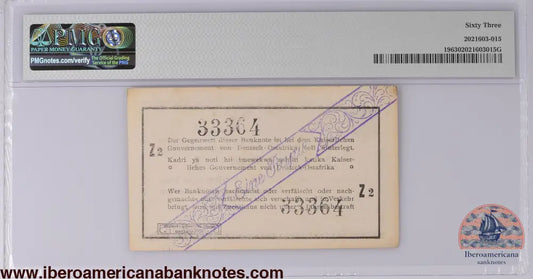
German East Africa 1.2.1916 P-19 PMG Choice UNC 63 1 Rupee
Vendor:Iberoamericana BanknotesRegular price €114,95 EURRegular price €114,95 EUR Sale priceUnit price / per€124,95 EURSale

Collection: German East African Banknotes: An Unmissable Collection for the German Banknote Collector
Welcome to our exclusive collection of German East African banknotes! If you're passionate about numismatics, collectible German East African (Deutsch-Ostafrika) banknotes offer a unique window into the rich historical, colonial, and economic heritage of this former German colony in East Africa, encompassing present-day Tanzania, Burundi, and Rwanda. In this comprehensive guide, we'll explore the evolution of the German East African rupee, from its colonial-era origins to emergency issues during World War I, highlighting rarities, values, and collector tips. We invite you to immerse yourself in the world of collectible German East African banknotes, perfect for enriching your collection. In our shop, you'll find authentic pieces, from vintage 1905 banknotes featuring Kaiser Wilhelm II to unique 1915-1916 wartime editions. Keywords such as "collectible German East African banknotes", "Deutsch-Ostafrika banknote collection" and "buy old German East African banknotes" will guide you on this adventure.
Introduction to Collectible Banknotes from German East Africa
German East Africa, known as Deutsch-Ostafrika, was a German colony established in 1884 by the Deutsch-Ostafrikanische Gesellschaft (German East Africa Company) under Kaiser Wilhelm II. This vast region, which included resource-rich territories such as ivory, rubber, and cotton, saw the introduction of its own currency to facilitate trade and colonial administration. The German East African rupee (Rupie) was used from the late 19th century until the end of World War I in 1918, when the colony was divided among the Allied powers. These banknotes are not just monetary relics; they are artifacts that tell the story of German imperial expansion, local rebellions such as the Maji-Maji (1905–1907), and the impact of global warfare on Africa.
Formally introduced in 1904-1905, the Rupee gradually replaced Indian and local currencies, with an initial parity of 1 Rupee = 16 Annas = 64 Pesa, and from 1906, 1 Rupee = 100 Heller (cents). Today, these banknotes are notable for their imperial designs, featuring portraits of the Kaiser and African scenes, and for their emergency issues printed under precarious wartime conditions. In our foreign banknote shop, we offer banknotes in excellent condition, ideal for both beginners and experts. Imagine holding a 5 Rupee note from 1905 depicting lions on the savanna, or a rare 200 Rupee note from 1916 issued during wartime. These items not only have numismatic value but are also potential investments, as rare German East African banknotes can appreciate in value over time, especially at international auctions.
A high-grade 100 Rupien note from 1905 can fetch over $1,000 USD. German colonial numismatics has gained popularity in recent years, fueled by interest in imperial and African history. Now, with the rise of online shopping and virtual exhibitions, platforms like Shopify make these pieces easily accessible. If you're looking for "collectible German East African banknotes," our shop is the perfect destination, offering secure shipping and guaranteed authenticity.
History of German East African Currency: From Colony to War
The history of German East African banknotes dates back to the German colonial era. Before 1905, the region used Indian and local currencies, but the German East African Society (Deutsch-Ostafrikanische Gesellschaft), founded in 1885, obtained the right to issue currency in 1891. Initially, silver coins in denominations of 1/4, 1/2, 1, and 2 rupees were minted in Berlin, bearing the portrait of Wilhelm II and the company's emblem (a lion and a palm tree). These coins circulated alongside the Indian rupee, but the need for paper money arose with economic growth.
In 1905, the Deutsche-Ostafrikanische Bank was established in Dar es Salaam, with a monopoly on banknote issuance. The first series, dated June 15, 1905, included denominations of 5, 10, 50, 100, and 500 rupees, printed by Giesecke & Devrient in Leipzig. These banknotes were introduced to facilitate transactions in coastal cities and along railway lines. The series reflected imperial pride: the higher denominations depicted the Kaiser in military uniform, while the lower denominations featured local scenes such as lions or the port of Dar es Salaam. Total production was limited: for example, only 696 500-rupe notes were issued, totaling 348,000 rupees.
The Maji-Maji Rebellion (1905–1907) disrupted circulation, leading to temporary local issues, such as post office notes in Lindi and Kilwa, or even German naval ship money. During World War I (1914–1918), German forces under Paul von Lettow-Vorbeck resisted through guerrilla warfare, leading to emergency issues in 1915–1916. These "War Notes" (Kriegsgeld) were printed under makeshift conditions, often in Tabora or on mobile presses, in denominations of 1, 5, 10, 20, 50, and 200 rupees. They used plain paper, without advanced watermarks, and bore handwritten signatures or stamps for authenticity. Following the German defeat in 1918, the rupee was replaced by the British East African shilling in Tanganyika.
Old banknotes from German East Africa, especially those from the 1905 series, are highly collectible. For example, a 50 Rupien note from 1905 in circulated condition can be worth around $200-$500 USD, but in uncirculated condition (UNC), it exceeds $1000 USD.
Denominations of German East African Banknotes
The banknote series of German East Africa are limited to two main ones: the civilian series of 1905 and the wartime series of 1915-1916. There are no "current" issues as the colony ceased to exist, but historical denominations include:
1905 Series (Civil) : Denominations of 5, 10, 50, 100, and 500 Rupees. Distinctive colors: 5 Rupees green (lions), 10 Rupees blue (port), 50 Rupees red (Kaiser), 100 Rupees brown (Kaiser), 500 Rupees violet (Kaiser with hat). Approximate dimensions: 140 x 80 mm for lower denominations, larger for higher denominations. Printed on paper with a "Kreuzstern" (cross and star) watermark.
5 Rupien : Lions in the savanna, reverse with geometric patterns.
10 Rupien : View of the port of Dar es Salaam, with a ship anchored.
50 Rupien : Portrait of Wilhelm II looking to the right.
100 Rupien : Similar to 50, but brown.
500 Rupien : Different portrait of the Kaiser, looking to the left.
1915-1916 Series (War) : Denominations of 1, 5, 10, 20, 50, and 200 rupees. Printed on makeshift paper, with varying stamps and signatures. The 1 rupee is the lowest denomination, often printed in green; the 200 rupee, rare, is printed in blue. These banknotes lack sophistication but include German and Swahili texts for local circulation.
Unique Safety and Design Features
German East African banknotes incorporated anti-counterfeiting technologies of the time, making authentic pieces valuable to collectors. The 1905 series included "Kreuzstern" watermarks, red serial numbers, and fine engravings by Giesecke & Devrient. During wartime, hand seals and the signatures of officers such as von Lettow-Vorbeck were used for authentication.
One curious aspect is the bilingualism: texts in German ("Deutsch-Ostafrikanische Bank") and local elements such as African scenes. The imperial designs promote colonial pride, featuring the Kaiser in uniform. For collectors, identifying authenticity is key. Look for watermarks, unique serial numbers (prefixed "No."), and check catalogs such as Dr. Keller's.
Tips for Collectors of German East African Banknotes
Starting a collection of East African banknotes is exciting, given their historical rarity. Begin with basic sets from the war series, available for under $100 USD. For rarities, focus on 1905 banknotes, such as the 500 Rupien, which can fetch $500-$2,000 USD in uncirculated condition. Store them in protective albums to prevent damage from moisture or light. With the growing interest in colonial history, these banknotes could appreciate by 10-20% annually. Our Shopify collection includes free beginner's guides.
Why Buy from Our Store of Old and Modern Foreign Banknotes?
Our collection is curated by experts, with worldwide shipping and easy returns. Explore "buy German East Africa banknotes online" and join thousands of satisfied collectors.