Explore Angolan Notaphily: A Tribute to Independence and Resilience
Immerse yourself in the captivating world of Angolan banknotes, where each one tells the story of Angola's epic struggle for independence, rich cultural heritage, and economic evolution, from its Portuguese colonial era to its modern sovereignty. At Iberoamericana Banknotes , we present our meticulously curated collection of Angolan banknotes , perfect for both seasoned collectors and new buyers passionate about the monetary legacy of this vibrant African nation. Angolan banknotes are more than just paper money; they are relics that encapsulate the introduction of the kwanza in 1977. Named after the Kwanza River, a symbol of fertility and national resilience, the kwanza was issued following independence from Portugal in 1975, marking the end of centuries of colonization.
The Monetary Evolution of Angola: From the Colonial Escudo to the Kwanza
Before 1977, Angola used the Angolan escudo , equivalent to the Portuguese escudo and subdivided into 100 centavos, issued by the Bank of Angola from 1926. During the colonial era, banknotes such as the 50-centavo peso note of 1923 featured allegories of Portugal as a colonizing power, with a white lady crowning a globe under a classical portico, reflecting the European domination formally established in 1884 after the Berlin Conference. In 1911, the angolar (equivalent to the escudo) was introduced, with 1- and 2.5-angolar banknotes from 1942 and commemorative notes from 1948 highlighting local motifs such as landscapes and imperial symbols.
Independence on November 11, 1975, brought the creation of the kwanza , officially adopted in 1976 at par with the escudo, and issued by the National Bank of Angola (BNA) in 1977 with banknotes dated 1975 in denominations of 20, 50, 100, 500, and 1,000 kwanzas. The 20-kwanza banknote was replaced by a coin in 1978. The hyperinflation of the 1990s forced reforms: in 1990, the novo kwanza (AON) was introduced, with overprints on older banknotes of 500, 1,000, and 5,000 novo kwanzas; in 1995, the readjusted kwanza (AOR) was introduced with denominations up to 500,000. and in 1999, the current kwanza (AOA), stabilizing the currency with banknotes of 100 to 500,000 readjusted kwanzas.
Rare Banknotes: Jewels of Angolan Notaphily
Our collection features rare Angolan banknotes , such as the colonial issues of Angolan angolares from the 1940s: 1 and 2.5 angolares from 1942 (featuring Portuguese sovereignty motifs), 5 angolares from 1947, 10 from 1946, 20 and 50 from 1944, and 100 from 1946, printed by the Bank of Angola with designs that capture the coffee and oil economy under colonial rule. Post-independence banknotes include pieces like the first kwanzas from 1977, featuring the portrait of António Agostinho Neto, the first president and leader of the MPLA (People's Movement for the Liberation of Angola), on the obverse of every note, symbolizing the transition from colony to republic.
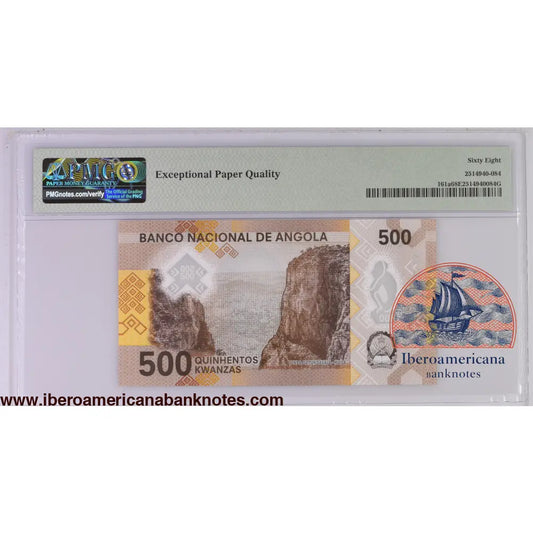
For enthusiasts of African banknotes , we include unique series such as the 1990 Novos Kwanzas with overprints (up to 5,000), the 1995 readjusted Kwanzas with extreme denominations like 500,000 due to hyperinflation, and the BNA's modern 2013 series in 50, 100, 200, and 500 Kwanzas, featuring Neto and José Eduardo dos Santos on the obverse, and reverses celebrating waterfalls such as Cuemba (50 Kwanzas), Binga (100), and Tchimbue (200). Current denominations include 1,000, 2,000, and 5,000 Kwanzas with motifs of Angolan fauna and culture. The rarity of banknotes such as the 50 cents of 1923 or the kwanzas of 1977, with initial print runs limited by the civil war (1975-2002), makes them coveted in international auctions, valued for their link to independence and the oil economy that drove reforms in 1999.
Preservation and Authenticity: Our Promise
Conservation is essential in our selection of Angolan banknotes . Each piece is graded on standard scales such as VF (Very Fine) or UNC (Uncirculated), preserving details like watermarks with the national coat of arms or Neto, fluorescent fibers, and BNA signatures. We recommend that collectors of rare banknotes verify them under UV light, where elements such as serial numbers and central designs glow in specific shades, according to BNA standards. At Iberoamericana Banknotes , all pieces are verified by experts to ensure their authenticity , avoiding common forgeries such as crude printing or missing security threads, frequent in colonial or hyperinflationary-era replicas.
Why Collect Angolan Banknotes
From the 1995 readjusted 100 kwanzas note featuring Neto and independence motifs, to the 2013 500 kwanzas note with two saints and iconic waterfalls, this collection offers a window into Angolan history: its anti-colonial resistance, its war for freedom, and its economic rebirth. Each note evokes milestones such as the Berlin Conference of 1884, independence in 1975, and the stabilization period of 1999. For new collectors , it's an accessible entry into collecting with cultural value; for experienced collectors , it's a chance to complete series with colonial or hyperinflationary issues that appreciate over time.
Trust Iberoamericana Banknotes
At Iberoamericana Banknotes , we guarantee the authenticity of every banknote with detailed certificates and expertise in Ibero-American and African numismatics. We offer pieces in optimal condition for your collectible collection and facilitate secure and discreet international shipping to any destination. Discover the pulse of Angolan notaphily and own a piece of history with Iberoamericana Banknotes .