No products found
Use fewer filters or remove all

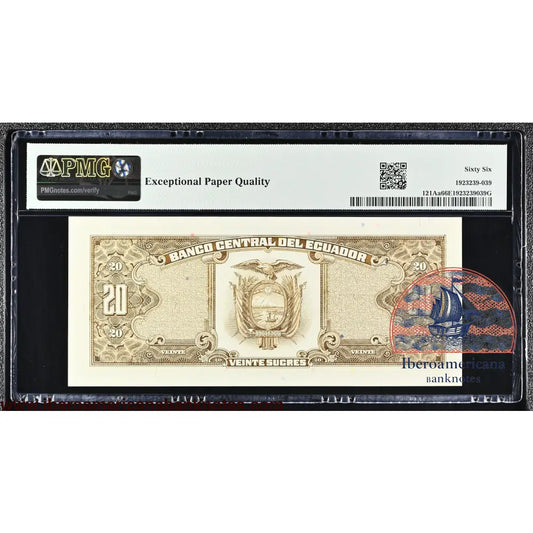
Collection: Banknotes of Ecuador: sucre, dollar and Andean wealth of the Land of the Middle of the World

Discover Ecuadorian Notaphily: A Tribute to Culture and Independence

Immerse yourself in the vibrant world of Ecuadorian banknotes , where each bill reflects the country's rich cultural heritage, struggle for independence, and geographical diversity, from the Andes to the Amazon and the Galápagos Islands. At Iberoamericana Banknotes , we present our carefully curated collection of Ecuadorian banknotes , perfect for both seasoned collectors and new buyers passionate about the monetary heritage of this fascinating South American nation. Ecuador's vintage banknotes are more than just paper money: they are relics that chronicle the evolution of the sucre , introduced in 1884 and replaced by the US dollar in 2000, symbolizing the history of a nation marked by its independence in 1830 and its subsequent economic transition.

The Monetary Evolution of Ecuador: From the Peso to the Sucre and to the Dollar

Before 1884, Ecuador used the peso , a colonial currency inherited from Spanish rule. The introduction of the sucre , named after the liberator Antonio José de Sucre, marked a milestone after the consolidation of independence. The first 5-sucre banknotes, issued in 1884 by private banks such as the Banco del Ecuador, featured designs with Sucre and agricultural motifs like cacao. In 1927, the Central Bank of Ecuador (BCE) , founded that year, assumed exclusive control of banknote issuance. The economic crisis of the 1990s led to dollarization in 2000, after which sucre banknotes were withdrawn, but they remain sought after by collectors.

Rare Banknotes: Jewels of Ecuadorian Notaphily

Our collection includes rare Ecuadorian banknotes , such as the 1871-1884 peso issues in denominations of 1, 4, and 20 pesos, featuring engravings of Simón Bolívar and scenes of the port of Guayaquil. The 1928-1999 sucre series are notable for their designs featuring Gabriel García Moreno (on the 10-sucre note ) and views of the Quito Cathedral. Commemorative issues, such as the 1999 50,000-sucre note for the centenary of Eloy Alfaro's birth, depict the revolutionary leader and the trans-Andean railway.

For enthusiasts of South American banknotes , we offer unique pieces such as the 1,000-sucre banknote from 1988, featuring the naturalist Alexander von Humboldt and the Galápagos Islands, and the 10,000-sucre banknote from 1996, highlighting Vicente Rocafuerte and Andean fauna such as the condor. These banknotes incorporate advanced security features for their time, such as metallic threads, optically variable inks, and microtext, introduced in 1984. The rarity of issues like the 5-sucre banknote from 1928 or the last series from 1999, with limited print runs before dollarization, makes them coveted pieces at international auctions, valued for their connection to Ecuadorian independence and biodiversity.

Preservation and Authenticity: Our Promise

Conservation is a key pillar in our selection of Ecuadorian banknotes . Each piece is evaluated according to international standards such as VF (Very Fine) or UNC (Uncirculated), guaranteeing the clarity of details like watermarks with the Ecuadorian coat of arms, fluorescent fibers, and the signatures of the Central Bank of Ecuador (BCE) governors. We recommend that collectors of rare banknotes verify authenticity under UV light, where elements such as serial numbers and cultural motifs glow in shades of green or blue, in accordance with BCE standards. At Iberoamericana Banknotes , each banknote undergoes a rigorous verification process to guarantee its authenticity , preventing common counterfeits such as printing defects or missing security threads, which are frequent in replicas of pre-dollarization banknotes.

Why Collect Ecuadorian Banknotes

From the 5-sucre note of 1928, featuring Antonio José de Sucre and the Imbabura volcano, to the 20,000-sucre note of 1999, featuring Juan Montalvo and the city of Cuenca, this collection celebrates Ecuadorian identity: its geographical diversity, its legacy of liberation, and its rich history. Each note reflects milestones such as the founding of the Central Bank of Ecuador in 1927 or dollarization in 2000. For new buyers , it's an opportunity to invest in pieces with historical value; for experienced collectors , it's a chance to complete series with rare or commemorative denominations that enrich any collection.

Trust Iberoamericana Banknotes

At Iberoamericana Banknotes , we guarantee the authenticity of every banknote with detailed certificates and expertise in Ibero-American numismatics. We offer pieces in optimal condition to enhance your collecting legacy and provide secure and discreet international shipping to any destination. Embark on a journey through Ecuadorian banknotes and own a piece of history with Iberoamericana Banknotes .