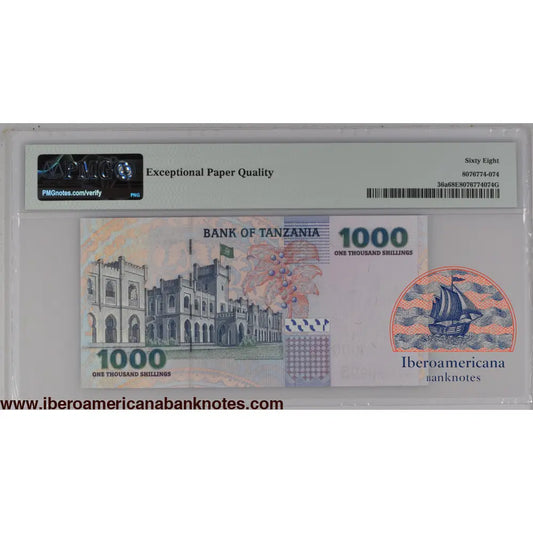
Collection: Tanzanian banknotes: wildlife and African spirit under Kilimanjaro

Discover Tanzanian Notaphily: A Tribute to Unity and Biodiversity

Immerse yourself in the vibrant world of Tanzanian banknotes , where each one reflects the rich history, national unity, and extraordinary biodiversity of Tanzania, home to the majestic Kilimanjaro and Olduvai Gorge, the cradle of humanity. At Iberoamericana Banknotes , we present our carefully curated collection of Tanzanian banknotes , perfect for both seasoned collectors and new buyers passionate about the monetary heritage of this iconic East African nation. Vintage Tanzanian banknotes are more than just paper money: they are relics that chronicle the introduction of the Tanzanian shilling in 1966, following the independence and unification of Tanganyika and Zanzibar, symbolizing unity and the legacy of the African revolution.

The Monetary Evolution of Tanzania: From the East African Shilling to the Tanzanian Shilling

Before 1966, Tanganyika, as part of British East Africa, used the East African shilling , issued by the East African Monetary Board. Following Tanganyika's independence in 1961 and its unification with Zanzibar in 1964 to form Tanzania, the Bank of Tanzania , founded in 1965, introduced the Tanzanian shilling (TZS) in 1966, replacing the East African shilling at par. The first 5-shilling banknotes, issued on June 14, 1966, featured designs with President Julius Nyerere, the Father of the Nation, and agricultural motifs such as coffee. Modern banknotes highlight iconic Serengeti wildlife and cultural landmarks, reflecting the country's economic stability and natural wealth.

Rare Banknotes: Jewels of Tanzanian Notaphily

Our collection includes rare Tanzanian banknotes , such as the 1958–1964 East African shilling issues in 5, 10, 20, and 100 shilling denominations, featuring portraits of Queen Elizabeth II and scenes of Dar es Salaam harbor. The 1966–1984 Tanzanian shilling series are notable for their designs featuring Nyerere (on the 10 shilling ) and views of the Torch of Freedom on Kilimanjaro. Commemorative issues, such as the 2010 2,000 shilling note for the 50th anniversary of independence, feature the State Palace and the Serengeti lion.

For enthusiasts of African banknotes , we offer unique pieces such as the 1993 10,000 shilling banknote, featuring elephants and the Bank of Tanzania building, and the modern 2020 5,000 shilling banknote, highlighting Mwalimu Nyerere and the black rhinoceros. These banknotes incorporate advanced security features, including metallic threads, optically variable inks, microtext, and tactile elements for the visually impaired, introduced since 2003. The rarity of issues such as the 1966 5 shilling banknote or the 1980 series, with limited print runs during periods of inflation, makes them coveted pieces at international auctions, valued for their connection to Tanzanian unification and biodiversity.

Preservation and Authenticity: Our Promise

Conservation is a key pillar in our selection of Tanzanian banknotes . Each piece is assessed according to international standards such as VF (Very Fine) or UNC (Uncirculated), guaranteeing the clarity of details like the giraffe watermark, fluorescent fibers, and the signatures of the Governors of the Bank of Tanzania. We recommend that collectors of rare banknotes verify authenticity under UV light, where elements such as serial numbers and wildlife motifs glow in shades of green or blue, in accordance with the bank's standards. At Iberoamericana Banknotes , each banknote undergoes a rigorous verification process to guarantee its authenticity , preventing common counterfeits such as printing defects or missing security threads, which are frequent in replicas of colonial or early banknotes.

Why Collect Tanzanian Banknotes

From the 1966 10-shilling note featuring Julius Nyerere and a sisal plantation to the 2020 1,000-shilling note depicting Serengeti National Park and the African buffalo, this collection celebrates Tanzanian identity: its postcolonial unity, its biodiversity, and its legacy of African socialism. Each banknote reflects milestones such as the 1964 unification or the founding of the Bank of Tanzania in 1965. For new buyers , it's an opportunity to invest in pieces with historical value; for experienced collectors , it's a chance to complete series with rare or commemorative denominations that enrich any collection.

Trust Iberoamericana Banknotes

At Iberoamericana Banknotes , we guarantee the authenticity of every banknote with detailed certificates and expertise in Ibero-American and African numismatics. We offer pieces in optimal condition to enhance your collecting legacy and provide secure and discreet international shipping to any destination. Embark on a journey through Tanzanian notaphily and own a piece of history with Iberoamericana Banknotes .