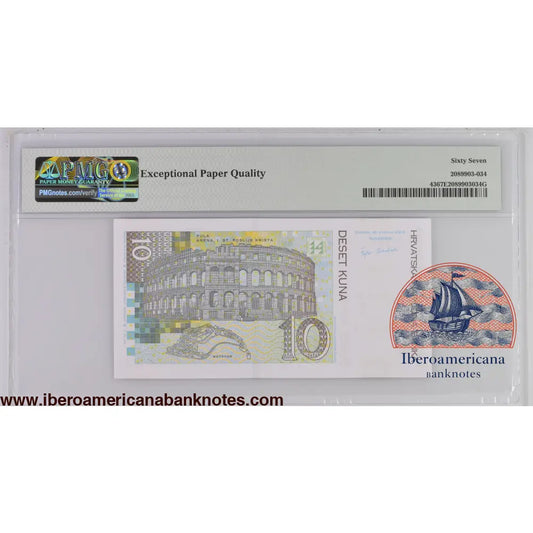
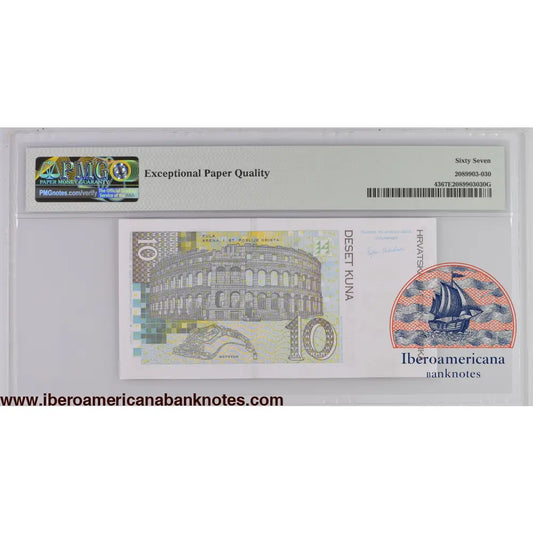
Collection: Explore the Dalmatian Heritage: Banknotes that Tell the Story of Croatia

Explore the dynamic and emerging Croatian Notaphily at Iberoamericana Banknotes. Our collection captures the history of Croatia's independence and cultural renaissance through its banknotes, from Yugoslav issues to the Kuna and the transition to the Euro, ideal for collectors interested in pieces with strong Balkan symbolism and post-Soviet value.

Explore Croatian Notaphily: A Tribute to Independence and Culture

Delve into the fascinating world of Croatian banknotes , where each one reflects Croatia's vibrant history, struggle for independence, and rich cultural heritage, from its medieval roots to its integration into Europe. At Iberoamericana Banknotes , we present our carefully curated collection of Croatian banknotes , perfect for both seasoned collectors and new buyers passionate about the monetary heritage of this beautiful Adriatic nation. Croatian banknotes are more than just paper money: they are relics that tell the story of the introduction of the kuna in 1994, a name inspired by the marten fur used as currency in the Middle Ages, symbolizing sovereignty after Croatia's independence from Yugoslavia in 1991.

The Monetary Evolution of Croatia: From the Dinar to the Kuna

Before 1994, Croatia used the Croatian dinar , an interim currency issued in 1991 during the War of Independence to replace the Yugoslav dinar. The kuna was officially introduced on May 30, 1994, by the National Bank of Croatia (HNB) , founded in 1990, marking the consolidation of the national economy. The first 1-kuna banknotes, issued in 1994, featured designs with the portrait of Josip Jelačić, a national hero who abolished serfdom in 1848, and views of the fortified city of Varaždin. In 2023, Croatia adopted the euro as its official currency, ending the circulation of the kuna, but its banknotes remain sought after for their historical value.

Rare Banknotes: Jewels of Croatian Notaphily

Our collection includes rare Croatian banknotes , such as the 1991-1994 issues in denominations of 1, 5, 10, and 25 Croatian dinars, used during the transition to the kuna. These banknotes feature figures like Rudjer Bošković, the 18th-century astronomer, on the 5 dinar note . The 1994 kuna series is notable for its designs, including Franjo Tuđman, Croatia's first president, on the 1,000 kuna note , and cultural motifs such as the National Theatre in Zagreb. Commemorative issues, such as the 2002 50 kuna note marking the tenth anniversary of independence, feature Diocletian's Palace in Split.

For enthusiasts of European banknote collecting , we offer unique pieces such as the 2002 200 kuna banknote featuring the Governor's Palace in Dubrovnik, and the latest 2014 500 kuna banknote, which highlights Marko Marulić, the father of Croatian literature. These banknotes incorporate advanced security features, such as metallic threads, optically variable inks, microtext, and Braille elements for the visually impaired, introduced since 2002. The rarity of issues such as the 1991 1 dinar banknote or the 1994 kuna series, with limited print runs due to the war, makes them coveted pieces at international auctions, valued for their connection to Croatian independence and Dalmatian culture.

Preservation and Authenticity: Our Promise

Conservation is a key pillar in our selection of Croatian banknotes . Each piece is assessed according to international standards such as VF (Very Fine) or UNC (Uncirculated), guaranteeing the clarity of details like watermarks with the Croatian coat of arms, fluorescent fibers, and the signatures of HNB governors. We recommend that collectors of rare banknotes verify authenticity under UV light, where elements such as serial numbers and cultural motifs glow in shades of green or blue, in accordance with HNB standards. At Iberoamericana Banknotes , each banknote undergoes a rigorous verification process to guarantee its authenticity , preventing common counterfeits such as printing defects or missing security threads, which are frequent in replica banknotes from the 1991-1994 transition period.

Why Collect Croatian Banknotes

From the 1994 10 kuna note featuring Rudjer Bošković and Šibenik Cathedral to the 2014 100 kuna note featuring Ivan Mažuranić and Trakošćan Castle, this collection celebrates Croatian identity: its struggle for independence, its coastal wealth, and its literary heritage. Each banknote reflects milestones such as the founding of the Croatian National Bank (HNB) in 1990 or the adoption of the euro in 2023. For new buyers , it's an opportunity to invest in pieces with historical value; for experienced collectors , it's a chance to complete series with rare or commemorative denominations that enrich any collection.

Trust Iberoamericana Banknotes

At Iberoamericana Banknotes , we guarantee the authenticity of every banknote with detailed certificates and expertise in Ibero-American and European numismatics. We offer pieces in optimal condition to enhance your collecting legacy and provide secure and discreet international shipping to any destination. Embark on a journey through Croatian notaphily and own a piece of history with Iberoamericana Banknotes .