Welcome to our exclusive collection of Kenyan banknotes on Shopify! If you're passionate about numismatics, Kenyan collectible banknotes offer a unique window into the rich cultural, historical, and economic heritage of this vibrant African country. In this comprehensive guide, we'll explore the evolution of Kenyan currency, from its colonial origins to modern series, highlighting rarities, values, and collector tips. We invite you to immerse yourself in the world of collectible Kenyan banknotes, perfect for enriching your collection. In our shop, you'll find authentic pieces, from vintage banknotes from the post-colonial era to limited editions with unique features.
Introduction to Collectible Kenyan Banknotes
Kenya, known for its stunning landscapes, wildlife, and cultural diversity, also boasts a fascinating monetary history that attracts collectors worldwide. Kenyan banknotes are more than just a medium of exchange; they are artifacts that chronicle the country's independence, its iconic leaders, and its economic evolution. Introduced in 1966, the Kenyan shilling (KES) replaced the East African shilling, marking the beginning of a sovereign era. Today, these banknotes are coveted for their bilingual design (English and Swahili), innovative security features, and depictions of Kenyan flora, fauna, and heritage.
In our collection, we offer Kenyan banknotes in excellent condition, ideal for both beginners and experts. Imagine holding a 100-shilling note from the 2019 series, featuring lions and elephants, or a rare 1970s note with the portrait of Jomo Kenyatta.
Kenyan numismatics has gained popularity in recent years, driven by global interest in African coins. If you're looking for "collectible Kenyan banknotes," our shop is the perfect destination, with secure shipping and guaranteed authenticity.
History of Kenyan Currency: From Colony to Independence
The history of Kenyan banknotes dates back to the British colonial era. Before independence in 1963, Kenya was part of the East African Community, using the East African shilling issued by the East African Currency Board. These banknotes, such as the 10-shilling note from 1958-1960, featured generic designs with African elements but no specific national identity. After independence, the Central Bank of Kenya (CBK), established in 1966, introduced the Kenyan shilling to assert economic sovereignty.
The first series of Kenyan banknotes, issued in 1966, included denominations of 5, 10, 20, 50, and 100 shillings. These banknotes were notable for featuring the portrait of Jomo Kenyatta, Kenya's first president, known as the "father of the nation." Kenyatta appeared on the obverse, while the reverse depicted agricultural scenes, such as coffee and tea harvests, reflecting the country's rural economy. This series was controversial; some criticized the prominence of political leaders on the currency, which led to subsequent reforms.
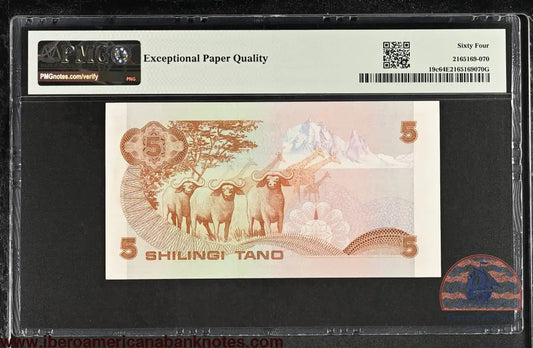
In the 1980s and 1990s, under President Daniel arap Moi, new series of banknotes featuring his portrait were issued. The 1985 series introduced security enhancements, such as metallic threads and watermarks, to combat counterfeiting. The 1995 series updated designs with a greater emphasis on Kenyan biodiversity, including elephants, giraffes, and Mount Kenya. A key milestone occurred in 2010 with the Kenyan Constitution, which prohibited portraits of living or deceased individuals on currency to promote neutrality. This culminated in the 2019 series, issued on May 31, which removed all portraits and focused on themes such as the "Big Five" (Africa's five largest animals: lion, elephant, buffalo, leopard, and rhinoceros), cultural heritage, and economic development.
Old Kenyan banknotes, especially those from the 1966-1980 series, are highly collectible. For example, a 1977 20-shilling note featuring Kenyatta in circulated condition can be worth around $10-$20 USD, but in uncirculated condition (UNC), it can fetch over $50 USD. Rarities such as proof prints or printing errors, like misaligned serial numbers, can reach hundreds of dollars at auction. In our Shopify collection, you'll find curated selections of these historic series, perfect for those looking for rare Kenyan banknotes.
Current Series and Denominations of Kenyan Banknotes
Kenyan banknotes have evolved to reflect technological and cultural advancements. Currently, the 2019-2024 series is dominant, with denominations of 50, 100, 200, 500, and 1000 shillings. Each banknote has a distinctive color for easy identification: the 50-shilling note is red, the 100-shilling note is green, the 200-shilling note is blue, the 500-shilling note is purple, and the 1000-shilling note is brown.
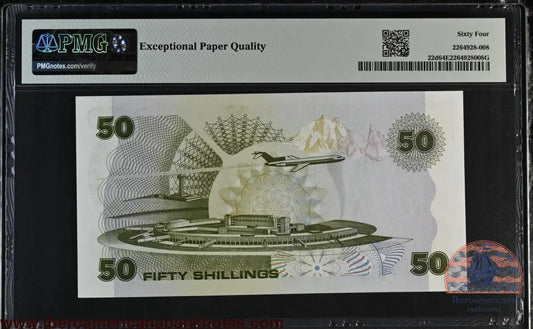
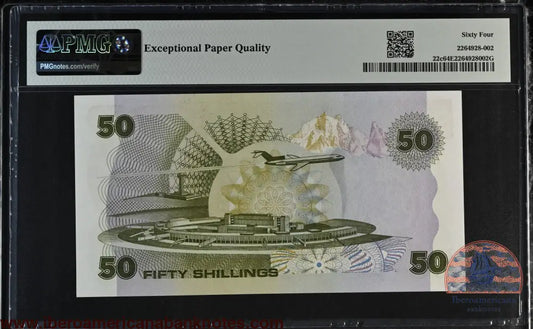
50 Shillings : This coin features the theme of "Green Farming." The obverse displays the coat of arms and abstract elements, while the reverse highlights solar panels and sustainable crops. Dimensions: 123 x 62 mm. Security features include a holographic stripe and color-changing ink.
100 Shillings : Focused on "Health." Includes images of medical facilities and vaccines. Solid security band with "100" and "CBK" visible when held up to the light. It is one of the most common in circulation, but early 2019 issues are collectible.
200 Shillings : Theme "Education". Depicts schools and books. Similar diameter, with tactile markings for the blind.
500 Shillings : "Tourism". Highlights wildlife, such as Maasai and safaris. It is the most widely used banknote, with collectible value in pristine condition.
1000 Shillings : "Governance". Includes Parliament and symbols of national unity. As the highest denomination, it is prone to counterfeiting, so rare authentic versions are worth more.
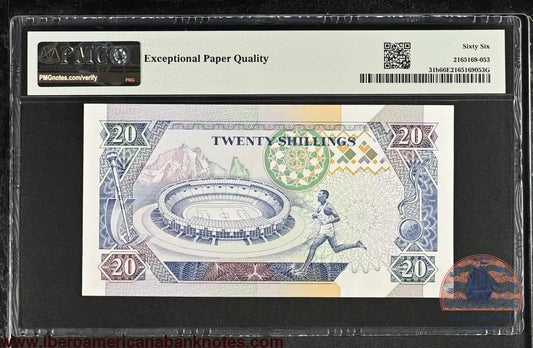
Before 2019, the series included additional denominations such as 10 and 20 shillings (now only available as coins). Banknotes from that era, such as the 2010 1000-shilling note featuring Kenyatta, are sought after by collectors. Numista notes that these banknotes use high-quality paper with cotton fibers and polymer in recent versions for increased durability.
In our shop, our Kenyan banknote collection includes these series, with options to purchase complete sets. If you are interested in "Kenyan banknote series," explore our listings for specific denominations.
Unique Safety and Design Features
Kenyan banknotes incorporate advanced anti-counterfeiting technologies, making genuine pieces even more valuable to collectors. Since the 1985 series, metallic security threads have been included; in 2019, holograms, optically variable inks (which change color when the banknote is tilted), and microtext legible only with a magnifying glass were added.
One interesting aspect is the bilingualism: denominations are written in both English ("One Hundred Shillings") and Swahili ("Shilingi Mia Moja"). This reflects Kenya's multiculturalism, with over 70 languages spoken. The 2019 series' thematic designs promote sustainability and heritage, avoiding political controversies.
Why Shop at Our Store?
Our collection is curated by experts, with worldwide shipping and easy returns. Explore "buy Kenyan banknotes online" and join thousands of satisfied collectors.