Welcome to our exclusive collection of Eastern Caribbean banknotes! If you're passionate about numismatics, collectible Eastern Caribbean banknotes offer a unique window into the rich cultural, historical, and economic heritage of this monetary union encompassing eight countries and territories: Anguilla, Antigua and Barbuda, Dominica, Grenada, Montserrat, Saint Kitts and Nevis, Saint Lucia, and Saint Vincent and the Grenadines. In this comprehensive guide, we'll explore the evolution of the Eastern Caribbean dollar (XCD), from its origins in 1965 to the modern polymer series issued between 2019 and 2024, highlighting rarities, values, and collector tips. We invite you to immerse yourself in the world of collectible Eastern Caribbean banknotes, perfect for enriching your collection. In our shop, you'll find authentic pieces, from vintage banknotes from the East Caribbean Currency Authority era to commemorative limited editions with unique features. Keywords such as "collectible Eastern Caribbean banknotes", "XCD banknote collection" and "buy antique Eastern Caribbean banknotes" will guide you on this adventure.
Introduction to Collectible Eastern Caribbean Banknotes
The Eastern Caribbean, a region of vibrant islands with white-sand beaches, diverse cultures, and a history marked by British colonialism, shares a common currency: the East Caribbean dollar (XCD). Issued by the Eastern Caribbean Central Bank (ECCB), established in 1983, this dollar has been pegged to the US dollar at a fixed rate of 1 USD = 2.70 XCD since 1976, providing economic stability to these nations dependent on tourism and agriculture. Eastern Caribbean banknotes are not just a medium of exchange; they are artifacts that tell the story of the islands' independence, their biodiversity, and their shared heritage. Introduced in 1965 by the East Caribbean Currency Authority (ECCA), the XCD replaced the British West Indies dollar, marking the beginning of a successful monetary union.
In our collection for sale, we offer Eastern Caribbean banknotes in excellent condition, ideal for both beginners and experts. Imagine holding a 1965 series $100 note featuring Queen Elizabeth II, or a rare 2024 polymer $50 note commemorating the 50th anniversary of Grenada's independence. These items not only have numismatic value but are also potential investments, as rare Eastern Caribbean banknotes can appreciate in value over time.
Eastern Caribbean numismatics has gained popularity in recent years, driven by global interest in coins from monetary unions and the rise of polymer banknotes. With the continued stability of the ECCB and potential design updates, this trend is expected to continue in 2026. If you're looking for "Eastern Caribbean collectible banknotes," our store is the perfect destination, offering secure shipping and guaranteed authenticity.
History of Eastern Caribbean Currency: From Colony to Monetary Union
The history of Eastern Caribbean banknotes dates back to the British colonial era. Before 1965, the region used the British West Indies dollar (BWI$), issued from 1935, with denominations such as 1, 5, 10, and 20 dollars. These generic banknotes featured imperial designs but lacked any specific local identity. Following the dissolution of the West Indies Federation in 1962, the eastern islands formed the East Caribbean Currency Authority (ECCA) in 1965 to issue a common currency, asserting their economic sovereignty.
The first series of XCD banknotes, issued in 1965, included denominations of $1, $5, $20, and $100. These banknotes were notable for featuring a portrait of Queen Elizabeth II on the obverse, with reverses depicting maps of the islands and elements such as ship sails and flying fish, reflecting maritime life. Each banknote carried a prefix letter in the serial number to indicate the island of issuance: A for Antigua, D for Dominica, G for Grenada, K for Saint Kitts, L for Saint Lucia, M for Montserrat, U for Anguilla, and V for Saint Vincent. This series was iconic, but controversial for its focus on the British monarchy.
In 1983, with the creation of the ECCB, new series with enhanced security features were launched. The 1985-1988 series added the $10 and $50 notes and updated designs with greater emphasis on Caribbean biodiversity, such as sea turtles, birds, and tropical flowers. The 1993 series introduced fluorescent inks and metallic threads to combat counterfeiting. A key milestone occurred in 2019-2021 with the transition to polymer banknotes, beginning with the $10, $20, $50, and $100 notes, followed by the $5 note in 2021. These polymer banknotes, produced by De La Rue, are more durable and secure, featuring themes such as "Prosperity, Unity, and Stability." In 2023, a commemorative $2 polymer banknote was issued for the ECCB's 40th anniversary—a rarity since the $2 note is not a standard denomination. In 2024, a commemorative $50 note celebrated Grenada's 50th anniversary of independence.
Old banknotes from the Eastern Caribbean, especially those from the 1965-1980 series, are highly collectible. For example, a 1965 $100 note with the letter "M" (for Montserrat) in circulated condition can be worth around $50-$100, but in uncirculated condition, it can exceed $500. Rarities such as specimens (proof prints) or printing errors, like misaligned serial numbers, can fetch thousands of dollars at auction.
Current Series and Denominations of Eastern Caribbean Banknotes
Eastern Caribbean banknote series have evolved to reflect technological and cultural advancements. Currently, the 2019-2024 polymer series dominates, with denominations of $5, $10, $20, $50, and $100, plus commemorative notes such as the $2 note in 2023 and the $50 note in 2024. Each banknote has a distinctive color for easy identification: the $5 note is gray, the $10 note is blue, the $20 note is green, the $50 note is purple, and the $100 note is red.
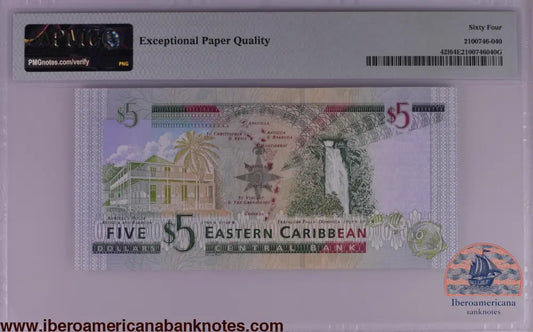
$5 : This note features biodiversity themes, such as the sea turtle. The obverse depicts Queen Elizabeth II (until recent updates), while the reverse highlights Admiralty Bay in St. Vincent. Dimensions: 145 x 69 mm. Security features include a holographic stripe and color-changing ink.
$10 : Focused on culture, featuring images of the Warrawarrow River in Dominica. Security band with "10" and "ECCB" visible when held up to the light. It is one of the most common in circulation, but early polymer editions are collectible.
$20 : "Tourism" theme, featuring the Nutmeg in Grenada. Similar diameter, with tactile markings for the visually impaired.
$50 : "Heritage," featuring Sir Arthur Lewis (Nobel Prize winner) and Brimstone Hill in St. Kitts. It is the mid-denomination, with collectible value in pristine condition.
$100 : "Economy," including the Eastern Caribbean Central Bank in St. Lucia. As the highest denomination, it is prone to counterfeiting, so rare authentic versions are worth more.
Before 2019, the paper series included the same denominations. Banknotes from those periods, such as the 1993 $100 note, are sought after by collectors. Numista notes that these banknotes use Guardian® polymer substrate for greater durability. A possible update featuring the portrait of King Charles III, similar to other British coins, is rumored for 2026.
In our store, our Eastern Caribbean banknote collection includes these series, with options to purchase complete sets. If you are interested in "XCD banknote series," explore our listings for specific denominations.
Unique Safety and Design Features
Eastern Caribbean banknotes incorporate advanced anti-counterfeiting technologies, making genuine banknotes even more valuable to collectors. Since the 1993 series, metallic security threads have been included; the 2019 polymer series added holograms, optically variable inks (which change color when the banknote is tilted), and microtext legible only with a magnifying glass. The polymer banknotes also include transparent windows with embossed images.
One curious aspect is the limited multilingualism: English names reflect the Anglophone status. The thematic designs promote regional unity, with shared elements such as the ECCB crest and maps of the islands. For collectors, verifying authenticity is key. Look for watermarks featuring the Queen or the crest, and check serial numbers against island letters.
Tips for Collectors of Eastern Caribbean Banknotes
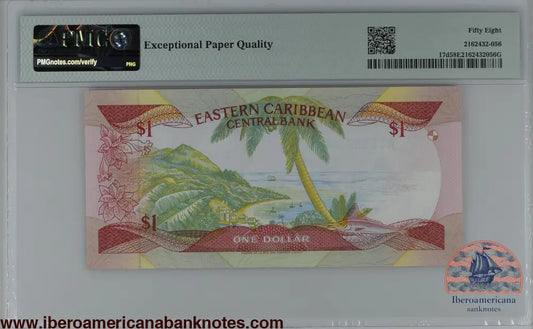
Starting an XCD banknote collection is accessible and exciting, given their regional rarity. Begin with basic polymer series sets, available for under $50 USD. For rarities, focus on pre-1983 banknotes, such as the withdrawn $1 bills, which can fetch $100-$500 USD in uncirculated condition. Store in protective albums to prevent damage from moisture or light.
Why Shop Our Shopify Collection
Our collection is curated by experts, with worldwide shipping and easy returns. Explore "buy Eastern Caribbean tickets online" and join thousands of satisfied collectors.